Your Analytics Tool and Server Logs Should Talk to Each Other. GDPR Doesn't Have to Stand in the Way.
Businesses obsess over analytics cookies while quietly storing enormous amounts of technical log data. Meanwhile, their analytics and monitoring systems often cannot answer one of the most important questions: why are customers struggling to use their services? It's time to rethink how we collect and use data.
Imagine you run an online store.
Last week, you released an updated checkout process. The new design looks better, the code passed testing, and your monitoring systems report no significant errors.
But conversion rates have dropped by 20%.
Your marketing team opens Google Analytics and discovers that more customers are abandoning the payment step.
Your developers check the server logs. Nothing unusual stands out. The payment API appears to be working, response times are acceptable, and no significant increase in HTTP errors has been recorded.
Perhaps customers simply dislike the new design.
Or perhaps a validation message is invisible on certain devices. Maybe a button doesn't respond as expected. Maybe users repeatedly attempt to submit a form that silently rejects their input.
Your analytics tool can tell you that customers are leaving. Your technical logs may contain clues about why. But you cannot easily connect the two.
And the situation becomes even more complicated when users reject analytics cookies.
You may still have operational logs from their interactions with your service, but you've lost much of the behavioral context needed to identify where they struggled.
The irony is difficult to ignore: businesses can collect extensive personal data in technical logs while being extremely cautious about collecting much less directly identifying information through web analytics.
And somehow, despite collecting all this information, they still struggle to understand whether their websites actually work.
Is this really what good privacy engineering looks like?
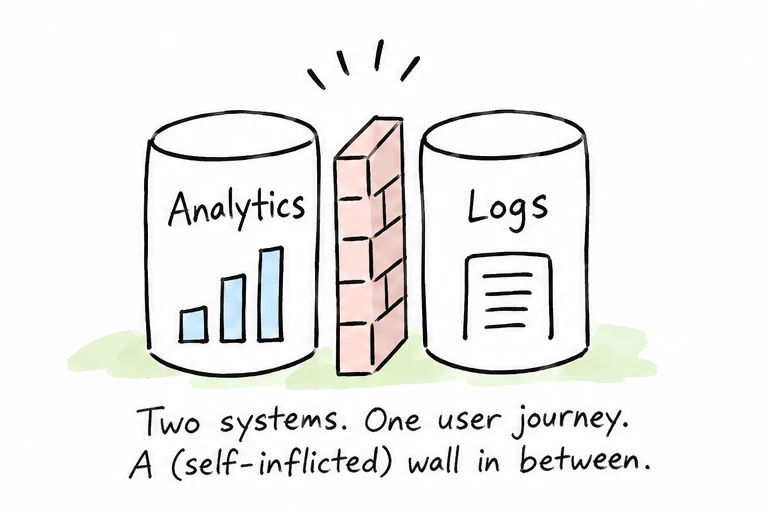
The artificial separation between analytics and technical logging
Most organizations operate two largely independent systems for understanding what happens on their websites.
Web analytics tools such as Google Analytics, Matomo and PostHog measure user behavior, conversion funnels, traffic sources and commercial performance.
Technical logging and monitoring systems record requests, application events, errors, performance information and security-related activity.
These systems serve different purposes and often have different legal bases, access restrictions and retention periods.
That's reasonable.
A marketing analyst doesn't need unrestricted access to authentication logs or database errors. And developers don't necessarily need to know which advertising campaign brought a customer to the website.
But these distinctions become a problem when they prevent businesses from understanding what's happening.
A checkout failure doesn't neatly belong to marketing or IT. A confusing form can be both a UX problem and a cause of lost revenue. A button that appears to work but never completes an action may be a technical defect, even if the server returns HTTP 200.
The user's experience is one continuous process. Our systems insist on dividing it into disconnected pieces.
Your data architecture might just be your organizational chart
Conway's Law suggests that organizations tend to design systems that reflect their own communication structures.
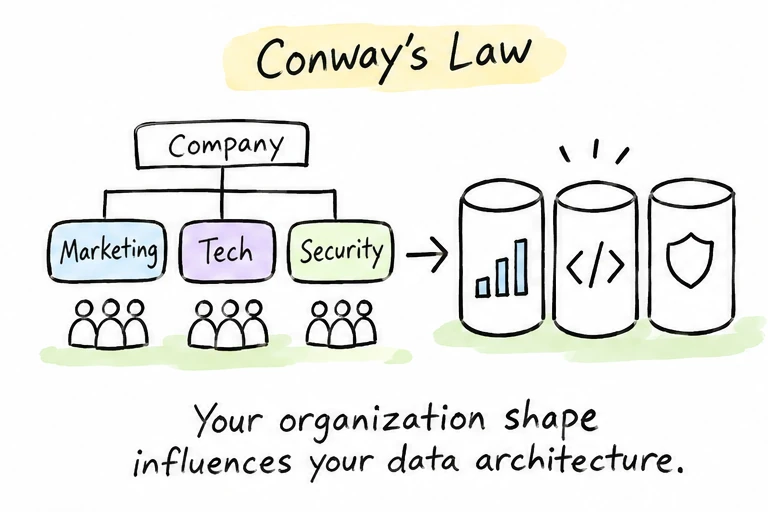
Look at how businesses organize themselves.
Marketing owns analytics. Developers own application logging. IT owns infrastructure monitoring. Security owns security logs. Privacy and legal teams establish the rules.
Is it surprising that we ended up with different systems, each telling part of the same story?
Of course, these technologies evolved independently and serve genuinely different needs. But organizational structure may help explain why the separation persists even when connecting the information would be useful.
The customer doesn't experience five departments. They experience one website.
Perhaps some of the boundaries we've come to accept as natural are simply reflections of how we've organized ourselves.
Not every technical failure produces an error message
Traditional monitoring is good at identifying obvious failures.
A database connection fails. An application crashes. An API returns HTTP 500.
But some of the most expensive failures never generate a conventional error.
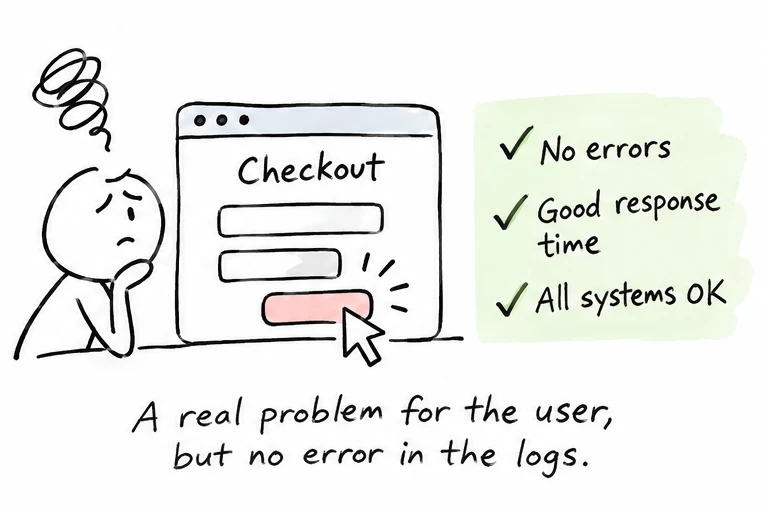
A customer clicks a checkout button. Nothing happens. They click again, and again, before leaving.
Every server request might have completed successfully. No exception was thrown.
Or consider a checkout form that rejects invalid input but displays its error message outside the visible part of the screen. The customer repeatedly submits the form without understanding what's wrong.
Is that a technical error, a UX problem or a conversion problem?
It's all three.
These are examples of soft errors: failures in the user experience that don't necessarily produce conventional technical errors.
An application can be technically healthy while failing its users.
To understand these problems, we need to connect behavioral information with technical events. Yet businesses often collect those two categories of data through systems that barely communicate.
We scrutinize analytics cookies while quietly accumulating server logs
Here's where the privacy discussion gets particularly strange.
Businesses spend considerable resources evaluating web analytics.
Can we collect this event? Does this cookie require consent? Can we recognize the same session across multiple page views? How long may we retain analytics data?
These are legitimate questions.
But how often do businesses apply the same scrutiny to their technical logs?
A typical logging environment might contain IP addresses, timestamps, request URLs, user agents, session references and application parameters.
Sometimes logs even contain authentication tokens or personal information that should never have been recorded.
The data is collected automatically, sent to centralized infrastructure and retained according to whatever settings someone configured.
Those settings may have been carefully evaluated. Or they may have remained unchanged for years.
Meanwhile, the same company may hesitate to record whether a visitor clicked a checkout button.
We debate whether recording a page view is acceptable while retaining detailed records of the underlying HTTP requests.
The activities have different purposes and legal requirements. In particular, ePrivacy rules impose additional obligations on cookies and similar tracking technologies.
But those differences don't justify treating technical logs as an afterthought.
Legitimate interest is not a privacy exemption
Technical logging is frequently justified through legitimate interests under GDPR Article 6(1)(f), although other legal bases may apply.
Businesses have legitimate reasons to maintain reliable, secure systems.
But legitimate interests do not exempt processing from the GDPR's other principles.
Data minimisation, storage limitation, security and accountability still apply.
Consent-based analytics isn't exempt from these requirements either.
The GDPR doesn't say that personal data becomes less personal when it's stored in Elasticsearch rather than Google Analytics.
Perhaps businesses should stop assuming their technical logs are acceptable simply because someone labelled them "necessary for operations".
The data deserves a proper assessment, regardless of which department collects it.
The privacy debate has its own blind spots
Businesses aren't solely responsible for this imbalance.
Privacy authorities, legal advisers and compliance professionals have devoted enormous attention to cookies and web analytics.
There are good reasons for that. Online tracking can involve persistent identification, profiling and third-party disclosures. The ePrivacy rules also impose specific requirements.
But the prominence of cookie compliance can create a distorted picture of what privacy protection actually involves.
A website with a perfectly implemented cookie banner is not necessarily a website with good data protection practices.
It may still retain unnecessarily detailed application logs, have overly broad internal access to diagnostic information or send extensive operational data to third-party monitoring providers.
Yet these issues rarely receive the same attention as the wording of an analytics consent button.
I'm not arguing that authorities should stop enforcing cookie requirements.
I'm arguing that we've become remarkably good at debating cookie consent while often paying far less attention to what happens to personal data everywhere else.
And privacy advisers should be willing to question whether restrictions actually serve a useful privacy purpose.
Saying no is easy. Anyone can recommend turning off analytics, avoiding session identifiers and collecting as little information as possible.
The harder job is figuring out how a business can get the information it genuinely needs without collecting more personal data than necessary.
That's where privacy expertise should add value.
GDPR doesn't require completely disconnected data systems
GDPR requires personal data to be collected for specified, explicit and legitimate purposes. Further processing must comply with the rules on purpose compatibility and applicable legal bases.
But purpose limitation doesn't establish a general requirement that information associated with different purposes must live in isolated systems.
In the 2022 Digi Távközlési judgment (Case C-77/21), the Court of Justice of the European Union considered whether personal data could be copied into a separate database for testing and correcting technical errors.
The Court held that purpose limitation doesn't automatically prevent such processing when it is compatible with the original purposes. It also emphasized that the data couldn't be kept longer than necessary for testing and error correction.
The judgment doesn't authorize unrestricted reuse of server logs for marketing.
But it illustrates something important:
GDPR requires us to control how personal data is used. It doesn't automatically require every legitimate activity to operate inside its own disconnected data silo.
Businesses have a legitimate interest in knowing whether their websites work
Here's where I think the conventional approach to web analytics deserves a more fundamental challenge.
I believe businesses have a legitimate interest in monitoring how visitors interact with their websites to determine whether those websites function as intended.
And I don't think that interest disappears because a visitor declines consent to commercial analytics.
Consider a simple question:
How many visitors attempt to complete a checkout, and how many fail?
To answer it properly, you need more than server error logs.
You may need to understand which steps visitors complete, where they stop, whether they repeatedly attempt an action and whether a particular browser or device is associated with failures.
That requires some form of session-level behavioral information.
Technically, this can resemble the event tracking performed by Google Analytics, although the necessary scope may be considerably narrower.
The objective, however, is different.
We aren't trying to build advertising audiences, attribute conversions to campaigns or develop long-term profiles of customers.
We're trying to understand whether the service we provide actually works.
I don't believe businesses should automatically need permission to investigate whether customers can successfully use the service they've requested.
That doesn't mean every form of session tracking is lawful without consent.
Under GDPR Article 6(1)(f), legitimate interests require an assessment of necessity, proportionality and the interests and rights of individuals. Whether the processing is genuinely necessary matters, as do users' reasonable expectations and the safeguards in place.
And there is an important complication: GDPR's legitimate-interests basis doesn't override ePrivacy requirements.
If an implementation stores information on or accesses information from the user's device, consent may still be required unless a relevant exception applies.
A first-party session cookie isn't automatically exempt simply because it's short-lived or used for troubleshooting.
So there is a real distinction between arguing that limited operational session monitoring can serve a legitimate interest and claiming that any particular tracking implementation can operate without consent.
But we shouldn't allow that complexity to end the discussion.
The interesting question is whether we can design systems that provide the diagnostic information a business genuinely needs, including for visitors who decline commercial analytics, without relying on unnecessary persistent identifiers or intrusive tracking techniques.
I believe we can do considerably better than today's typical setup.
What if analytics and technical logging were designed to work together?
Instead of starting with two disconnected datasets, one for marketing and one for IT, we could start with a different question:
What information do we need to understand whether the service works, where users struggle and why?
That doesn't mean collecting everything or giving marketing teams unrestricted access to server logs.
It means designing collection, permissions and retention around clearly defined purposes.
1. Detect problems with limited behavioral data
Suppose an online store releases a new checkout process.
| Metric | Previous release | New release |
|---|---|---|
| Checkout completion rate | 82% | 63% |
| Repeated submission attempts | 3% | 19% |
| Payment API errors | 0.4% | 0.5% |
| Average response time | 320 ms | 325 ms |
Illustrative figures.
The measurements suggest a serious problem with the user experience, even though backend monitoring reports normal performance.
You don't necessarily need to know who the visitors are to detect this pattern.
Short-lived event correlation and aggregate measurements may provide much of the information required.
Of course, the underlying collection still needs to be lawful. Aggregating identifiable data afterward doesn't retroactively justify collecting it.
But the design objective should be straightforward: collect enough information to detect failures, without automatically creating persistent behavioral profiles.
2. Allow controlled investigations
Once an anomaly has been identified, developers may need more information.
Perhaps a browser combination triggers an unexpected frontend issue. Perhaps an application event can be correlated with a backend trace.
Instead of making detailed logs available to everyone, the system could provide restricted access for specific investigations.
A product analyst might detect that checkout completion has dropped.
An authorized developer could investigate the relevant technical events.
The product team could receive the conclusion without receiving the underlying personal data.
Being able to investigate a problem is not the same as giving everyone unrestricted access to individual user journeys.
This type of asymmetric access could connect analytics and technical logging without turning operational diagnostics into general-purpose behavioral surveillance.
3. Reduce data detail as its usefulness declines
Most systems treat retention as a fixed deadline.
Keep logs for 30 days. Keep analytics for 14 months. Delete the data when the period expires.
But detailed diagnostic data may be extremely useful immediately after a deployment and almost worthless once the issue has been resolved.
Historical performance statistics can remain useful long afterward.
Why retain the same level of detail throughout the entire period?
Data should lose detail as it loses relevance
A better approach would be a progressive data lifecycle.
Instead of retaining detailed personal information until a deletion deadline, the system gradually reduces the information it keeps.
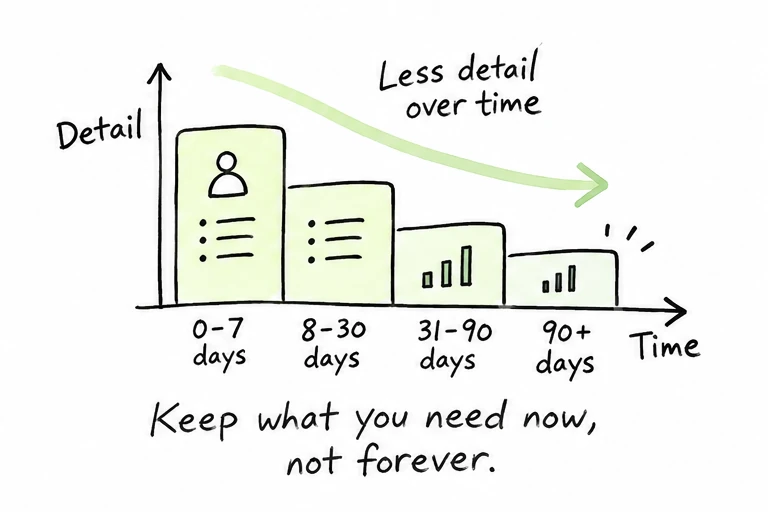
| Period | Information retained |
|---|---|
| Days 0–7 | Necessary detailed diagnostic events and short-lived correlation information |
| Days 8–30 | Reduced event details, with unnecessary identifiers deleted or transformed |
| Days 31–90 | Aggregated failure patterns, release information and operational metrics |
| Beyond 90 days | Genuinely anonymous historical performance statistics |
These periods are illustrative, not GDPR-prescribed retention rules.
Different purposes, data categories and incidents require their own assessments. Nor does replacing identifiers automatically make information anonymous.
But the principle is simple.
Data retention shouldn't just be about when we delete information. It should also be about how much detail we still need.
Knowing that checkout failures increased after a particular release may remain useful for years.
Knowing which IP address experienced a failed checkout three months ago probably doesn't.
A system that recognizes this distinction can preserve business insights while reducing unnecessary personal data.
The EU Digital Omnibus suggests the debate may be shifting
Some of these ideas are particularly interesting in light of the European Commission's Digital Omnibus proposals, presented in November 2025.
Among other changes, the proposals seek to simplify rules affecting online tracking and data protection.
Two elements are relevant here.
First, the Commission proposed additional exceptions to consent requirements for certain uses of cookies and similar technologies, including qualifying audience measurement.
Second, it proposed clarifications concerning when information should be considered personal data for a particular entity, taking account of whether that entity can reasonably identify an individual.
Both are relevant to the broader question of how we distinguish between intrusive tracking and lower-risk measurement, and how identifying information can be separated from information used for operational analysis.
The proposals have attracted criticism, particularly from the EDPB and EDPS over changes to the definition of personal data.
The legislative process is still ongoing. The Council adopted its negotiating position in October 2026, taking a different approach to parts of the proposal.
It's too early to know what the final rules will look like.
But I find it encouraging that some of the proposals move in the same direction as the argument made here: recognizing that different types of data processing deserve different treatment, rather than assuming every measurement creates the same privacy risk.
It will be interesting to see which ideas survive the legislative process and whether the result makes it easier to build genuinely privacy-conscious analytics and monitoring systems.
What would a better privacy-aware analytics platform look like?
Products such as PostHog and OpenReplay already combine elements of analytics, error monitoring, session replay and technical observability.
So connecting these capabilities isn't a new idea.
The more interesting challenge is designing a platform where privacy controls are fundamental to how information is collected and used.
I would start with five principles.
Purpose-aware collection. Operational monitoring, detailed diagnostics and commercial analytics should be distinct capabilities, each governed by the requirements applicable to its actual processing.
Useful aggregate information by default. Businesses should be able to identify failures and behavioral patterns without routinely examining identifiable user journeys.
Controlled access to detailed diagnostics. Authorized personnel should be able to investigate problems without automatically exposing detailed personal data to marketing or product teams.
Minimal identifiers and progressive retention. Correlation should last only as long as necessary, while detailed information should be reduced or deleted as its usefulness declines.
No automatic sharing with advertising systems. Internal operational data shouldn't flow into advertising platforms merely because they offer convenient analytics features.
None of these principles removes the need for a valid legal basis, an applicable ePrivacy assessment or proper transparency.
But they suggest a different way of thinking about analytics.
Rather than building separate systems around departmental ownership, we could build systems around the actual problems businesses need to solve.
Better privacy shouldn't mean worse visibility
The current approach produces an odd contradiction.
Companies collect extensive technical data, often without consistently evaluating the necessity of every field or its retention period.
At the same time, they can be extremely cautious about comparatively simple behavioral measurements.
And when customers encounter problems, the people responsible for fixing them may still lack the information they need.
Privacy regulation didn't create all these problems. Organizational structures, technology choices and compliance practices have all contributed.
But we shouldn't accept the resulting architecture as inevitable.
A system that stores detailed personal information nobody needs while preventing teams from identifying genuine service failures is not an impressive privacy achievement.
Nor is the answer to remove restrictions and collect everything.
We need more consistent privacy principles, better access controls, smarter retention and systems that recognize the overlap between technical quality and user behavior.
Businesses should be able to understand whether their services work, investigate why customers struggle and improve their commercial performance without treating every visitor as someone who must be continuously tracked.
Perhaps it's time we stopped asking whether information belongs to analytics or technical logging and started asking a more useful question:
What do we genuinely need to know, why do we need to know it, and how can we obtain that knowledge while respecting the people whose data makes it possible?
Sources and further reading
- General Data Protection Regulation — Regulation (EU) 2016/679 — Particularly Articles 5, 6, 25 and 32.
- CJEU, Case C-77/21, Digi Távközlési, 20 October 2022 — Purpose compatibility, technical error correction and storage limitation.
- European Data Protection Board, Guidelines 2/2023 — Technical scope of ePrivacy Article 5(3).
- CNIL, Draft Recommendation on Session Replay Tools, February 2026 — Technical troubleshooting, user-experience analysis and privacy requirements.
- European Commission, Digital Omnibus, November 2025 — Proposed simplifications to the EU's digital regulatory framework.
- Council of the EU, Digital Omnibus Negotiating Position, 21 October 2026 — Council position on data protection and cookie rules.
- EDPB and EDPS, Joint Opinion 2/2026 — Assessment of the Digital Omnibus proposals.